Study Finds 85% of Kratom-Derived Products Mislabeled

By Pat Anson

A new study at the University of Florida is likely to increase the growing scrutiny of kratom, 7-OH and other kratom alkaloid products.

Researchers found that the vast majority of kratom-derived tablets, edibles and extracts contain alkaloid and chemical compounds that differ substantially from their product labels, potentially putting consumers at risk.

Some have been altered so significantly during the manufacturing process that researchers concluded “these products are definitively not kratom.”

Kratom comes from the leaves of the Mitragyna speciosa tree in southeast Asia, where it has been used for centuries as a natural pain reliever and stimulant. In recent years, demand for kratom products has risen sharply in the United States, reaching an estimated market size of $2.56 billion in 2025.

As the kratom market has grown, so has the variety of products available, including concentrated formulations of 7-hydroxymitragynine (7-OH) and other kratom alkaloids that have “opioid-like” effects and are far more potent than natural leaf kratom.     

Researchers at the University of Florida College of Pharmacy conducted a laboratory analysis of 44 commercially available kratom-derived products purchased online and in stores in several U.S. states.

The study findings, published in the journal of Drug Testing and Analysis, show that 85% of the kratom products had ingredients and concentrations that did not match their labels. In some cases, products were labeled as having a single alkaloid, but multiple alkaloids were detected. Other products contained compounds that were not disclosed on their labels or were listed but not detected.

“The findings are of strong relevance to public health and underscore regulatory actions needed for proper labeling requirements by manufacturers for consumers to know what they are purchasing,” said co-author Christopher McCurdy, PhD, a Professor and Associate Dean for Faculty Development in the UF College of Pharmacy. 

“Right now, consumers are part of a large experiment in which they are taking products that they believe are properly labeled as to the composition of ingredients, yet they are being deceived intentionally or unintentionally by the manufacturers, putting the public at risk.”

McCurdy and his colleagues have spearheaded much of the U.S. research into kratom, with McCurdy serving as an expert witness in kratom litigation cases on both the plaintiff and defendant sides. 

Their research has grown more complicated in recent years, as the kratom market has been flooded by new semi-synthetic products that are often marketed as “natural kratom.” The DEA is currently planning to classify 7-OH and other concentrated kratom products as illegal Schedule One controlled substances, while keeping natural leaf kratom largely unregulated as a dietary supplement..

“Products containing semisynthetic, kratom-derived compounds should be clearly distinguished from natural kratom products,” says lead author Abhisheak Sharma, PhD, an Assistant Professor of Pharmaceutics in the UF College of Pharmacy. “Stronger manufacturing standards, comprehensive testing and transparent labeling are needed to help people make informed decisions and reduce potential safety risks.”

Kratom Litigation

Advocacy organizations for both natural leaf kratom and 7-OH products support stronger labeling, age restrictions and transparent marketing, but there is little effort to enforce those standards at the federal level. That has left most kratom regulation to individual states and local governments.

In a move reminiscent of the opioid litigation cases that cost the pharmaceutical industry over $50 billion dollars, the city of Baltimore recently filed a complaint against several manufacturers and distributors of kratom products, accusing them of “engaging in unfair, abusive, or deceptive trade practices.” 

Maryland has banned the sale of all synthetic or artificially altered kratom products under the state’s Kratom Consumer Protection Act, which also requires product labels to be accurate.

The Baltimore case focuses on several kratom entrepreneurs behind Optimized Plant Mediated Solutions (OPMS), a kratom brand that sells a potent kratom extract called Black Liquid Kratom that’s been linked to several deaths.

“Defendants have employed a web of shell companies and alter egos, and use multiple business names, assumed names, and trade names to hide the scope of their operation and to avoid liability for their actions… while falsely stating or implying in their labeling, packaging, advertising, and marketing of the Kratom Products that the Kratom Products are safe for consumption or offer therapeutic and health benefits that they do not have,” the complaint alleges.

In 2024, the FDA warned consumers not to use Black Liquid Kratom after it was linked to several adverse events. But the OPMS extracts are still available in smoke shops, vape shops and online, where they are often marketed as “all natural” kratom products.

OPMS is one of the “qualified vendors” registered with the American Kratom Association’s good manufacturing standards program, which requires vendors to have labeling that “provides all the information required for consumers to make an informed purchasing decision.”

In their analysis of Black Liquid Kratom, University of Florida researchers found the OPMS extracts “showed variability in their chemical composition, with measured content different from the values stated on the product labels.”  A laboratory analysis found more alkaloids in Black Liquid Kratom than what was indicated on the product label.

‘Enormous Confusion’ as Deadline Nears for 7-OH Kratom Ban  

By Pat Anson

Supporters of a DEA plan to classify 7-OH and other concentrated kratom alkaloids as illegal Schedule One controlled substances are worried an impending ban may affect kratom itself. 

The American Kratom Association (AKA), a group of natural leaf kratom vendors, led the effort to ban what it calls synthetic kratom alkaloids, claiming they are dangerous “opioid products.”  

But now the AKA is worried the DEA scheduling may backfire, saying there is “enormous confusion among some members of Congress and even staff at the DEA” about the differences between natural leaf kratom, 7-OH, and other kratom alkaloids.

At issue is mitragynine pseudoindoxyl, one of many naturally occurring kratom alkaloids. A proposed DEA order would ban all pseudoindoxyl products, which are potent analgesics sold as dietary supplements. 

But because there is no current way to measure pseudoindoxyl levels, the AKA is worried that natural levels of pseudoindoxyl will be banned too – in effect a ban on natural leaf kratom. 

“That’s part of the problem, the confusion,” explained Mac Haddow, an AKA lobbyist who says a “zero tolerance” approach to pseudoindoxyl could theoretically lead to bans on kratom. He wants a “carveout” for pseudoindoxyl and natural leaf kratom, exempting them from any DEA bans.     

“That’s why we made the recommendation to the DEA that they should clarify the distinction. The same kind of carveout for pseudoindoxyl would be appropriate, even though it might not be quantifiable at normal testing levels,” he said.

Haddow blames much of the confusion on 7-OH manufacturers, who say their products are just as natural as kratom. 

“The 7-OH that the body metabolizes from a whole leaf product is really indistinguishable from 7-OH that is in a 7-OH product,” says Jeff Smith, Executive Director of the Holistic Alternative Recovery Trust (HART), an advocacy group funded by 7-OH manufacturers.     

“I frankly don't understand why the traditional kratom people have pushed so hard (for a 7-OH ban) when their products have to be considered a precursor.” 

Kratom comes from the leaves of the Mitragyna speciosa tree in southeast Asia, where it has been used for centuries as a natural stimulant and pain reliever. In recent years, natural leaf kratom, 7-OH and other kratom alkaloid products have become popular in the United States, where they are used by millions of people to self-treat their pain, anxiety, depression, and substance use problems.  

Fearing they may also lead to addiction and overdoses, several states and dozens of cities and counties have banned 7-OH, and some have included kratom. 

The latest example is North Dakota, where the governor today declared a 30-day public health emergency banning all kratom products. Gov. Kelly Armstrong called for a special session of the legislature next month to make the ban permanent under state law.

“Doing nothing is not an option,” said Armstrong. “Right now, it's the Wild West when it comes to kratom and 7-OH sales in North Dakota: no regulations, no age limits, no accountability.  

“We’re taking emergency action to press pause and get these products off the shelves until the Legislature can address the issue.”   

A nationwide ban on 7-OH may be imminent. The DEA announced last month that it planned an emergency scheduling of 7-OH products as Schedule One controlled substances, the same classification as heroin and LSD. 

The scheduling order could take effect as soon as Wednesday, August 5. That has led to a run on 7-OH products in recent weeks, with 7-OH vendors slashing prices to dispose of as much inventory as possible before the ban takes effect. 

7-OH Retailers Slash Prices as DEA Deadline Looms

By Pat Anson

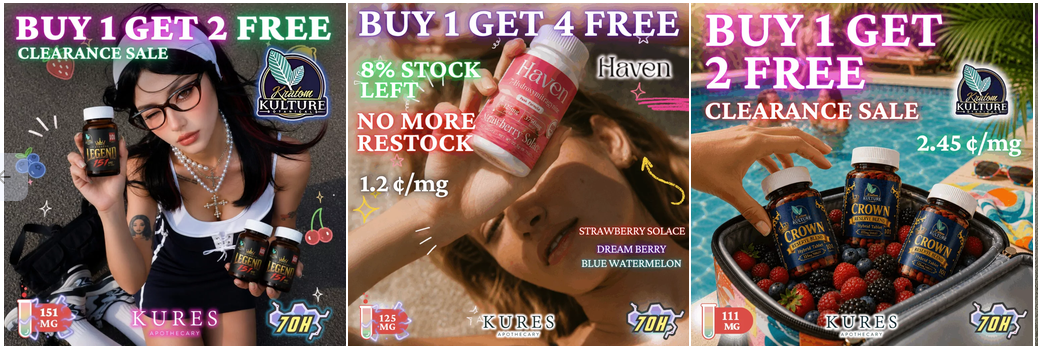
Online sellers of 7-OH products are offering major discounts on tablets, gummies and shots as a potential August 5 deadline nears for concentrated forms of the kratom alkaloid 7-hydroxymitragynine (7-OH) become illegal Schedule One controlled substances.

“Once they are gone, they are gone for good,” is how Payless Kratom is promoting its 7-OH clearance sale. Other online 7-OH promotions include multi-buy discounts and steep price breaks on bulk purchases.

“This is really the last chance to stock up,” said another 7-OH retailer.

KURES APOTHECARY

The DEA announced on July 6 in the Federal Register that it planned an emergency scheduling of all concentrated forms of 7-OH as illegal Schedule One controlled substances, the same classification as heroin and LSD.  

The scheduling order “will not be issued before August 5,” according to the DEA, and will remain in effect for at least two years, with a possible extension of an additional year.

Stockpiling 7-OH

With the August deadline fast approaching, retailers are getting rid of 7-OH products they will soon be prohibited from selling, and 7-OH consumers are stockpiling products while they can.  

“There is a fire sale going on at the website I get my 7 from,” said one Reddit poster. “They even have a countdown timer that's got the days, hours and seconds until they will no longer be taking orders if/when this goes into effect…. I just placed a massive order a few days ago and it's already on the way. It is probably my last order ever.”

“Prohibition is about to happen and I don’t know that it’s happened with something this popular in a while. We’re gonna see how addictive it is when it becomes a street drug. Turns a lot of otherwise law-abiding citizens into felons,” wrote another Reddit poster. “They’ll be arresting normal folks and destroying their families with drug court for something that was legal to purchase in a gas station 6 months ago.”

“With 7-OH becoming Schedule I in the coming days, I think we're approaching an inflection point. Healthcare workers should be prepared for a spike in both withdrawal presentations and ODs (overdoses),” warned a medical student. “Keep an eye out for both extremes over the next few weeks. Those that stockpiled and unintentionally OD or suddenly lose access and present in severe withdrawal that can resemble heroin or fentanyl withdrawal.”

Whether concentrated 7-OH is an “opioid” like fentanyl is disputed, but most 7-OH consumers acknowledge that it has opioid-like effects and is a good pain reliever.

“The effects of 7-OH on a person's body bear no resemblance to those of heroin or fentanyl,” says Jeff Smith, National Policy Director of the Holistic Alternative Recovery Trust (HART), an advocacy group funded by 7-OH manufacturers.    

Smith has chronic pain from two significant back injuries. The pain was so severe he couldn’t sleep more than 20 minutes at a time, until he started using 7-OH.  

“I've been using it for over a year, and it's helped me immensely with chronic pain and helps me sleep through the pain,” Smith told PNN. “So it has been transformative for me, and I know for tons of other people who I've met when I've gone and testified in different state capitals.  

“No other painkillers have helped. No other sleep medication has helped. I've tried 15 different things probably over the course of a decade or more, and this has really been the first thing that's helped meaningfully.”

HART has produced a documentary to counter what it calls false and misleading narratives about 7-OH. It features 7-OH consumers sharing personal stories of how 7-OH helped them overcome pain, anxiety and PTSD.

Local Bans Already in Effect

In some states, cities and counties, sales of 7-OH and kratom itself are already banned.

In recent months, California has seized nearly 7,000 kratom and 7-OH products, achieving what the state’s Alcoholic Beverage Control (ABC) agency calls a “98% compliance rate.”  

Ironically, many California retailers agreed to stop selling 7-OH and kratom products rather than run the risk of losing their licenses to sell alcohol – a substance that causes substantially more public health and safety problems. 

“After five months of targeted kratom and 7-OH enforcement efforts, nearly 98 percent of ABC-licensed locations are in compliance,” ABC Director Paul Tupy said in a statement. “This is possible through the collaboration of our licensees, who are making sure these harmful products aren’t available on store shelves.” 

Jeff Smith is unsure what will happen after August 5, a date when a window opens 30 days after the DEA’s scheduling order was published.

“The whole process has been so bizarre and herky-jerky that it's difficult to predict,” Smith said. “There is no outer time bound to this process, so 30 days is a minimum, but it's not a maximum. So they could take 60 days, or 90 days, or 180 days, or 365 days. I mean, they could take as long as they want to to address this. We just don't know what they'll do.”

Public Comments Show How 7-OH Ban Would Harm Pain Patients

By Crystal Lindell

Leigh Ann Matthews is a 51 year old woman with chronic pain. She lives alone, makes less than $2,000 per month, and can’t afford health insurance.

She relies on 7-OH for pain relief, and doesn’t know how she’ll be able to work if it’s banned.   

“Please don’t make me suffer with chronic pain by taking away the ONLY thing that has helped me tremendously,” she wrote. “I have no family or friends to lean on or help me. I don’t abuse 7-OH. I’m so afraid.”

Matthews is one of the thousands of people who have shared their stories in the Federal Register in response to the DEA announcing plans to make concentrated forms of the kratom alkaloid 7-hydroxymitragynine (7-OH) an illegal Schedule 1 controlled substance.

As of July 24, more than 20,000 comments had been submitted to the Department of Health and Human Services (HHS).  Reading through them makes some common themes jump out. There are thousands of personal, individual stories that are clearly coming from real people with real fears. 

Many are chronic pain patients, who say that 7-OH has given them their lives back. In fact, a search for the phrase "my life back" turns up 290 comments. A search for "chronic pain" returns 2,608 results.

"I'm a 50-year-old male with multiple sclerosis. I live my life with chronic pain,” wrote Gabriel Duley. “It is so hard to get out of bed to even take a shower. Doctors do not prescribe pain medications. Please do not take 7-OH away. It's the only thing that has given my life back to me."

Tyler Bartone is 30 years old and lives in Ohio. He wrote that he has suffered from chronic pain since he was 22, after a motorcycle accident broke both of his legs.

"Oxycodone, hydrocodone, Suboxone, and tramadol all got tried over those years, and none of them let me function the way I needed to,” Bartone wrote. “When I found 7-OH, that changed. I can walk my dogs now. I can play with my kids. I stopped relying on opioid pain medication because this actually worked for my pain in a way [that] those didn't."

He shared that he takes 30 to 60 mg of 7-OH spread across 4 to 5 doses a day, and that amount has stayed steady for the 1 to 2 years he has used it. 

"What scares me is what happens after a ban like this. People in my situation, and others I know who rely on 7-OH daily just to function, would be left with two options: go back to opioid prescriptions that didn't work as well, or turn to street drugs,” Bartone explained. “I know people would die from that second option. That is the real hazard here, not the milligrams in a tested tablet.”

Bartone said he would support rules that “keep this market honest.” Rules like a 21 and up age requirement, mandatory lab testing with published results, child-resistant packaging, and clear dosage labeling. 

Unrealistic Threshold

The DEA’s scheduling order limits the amount of 7-OH to no more than 0.05% of a product by weight or volume, the equivalent of about 0.5 mg 7-OH per tablet. Virtually all 7-OH products currently on the market have much higher dosages. Bartone thinks it’s an unrealistic threshold.

“I'm asking HHS to set any threshold based on how people actually take this, not a number that erases the product entirely,” Bartone said. 

Katherine Loperena, a 33 year old who works in sales and suffers from chronic pain, also shared her story. She said for the past 1 to 2 years she has used more than 60 mg of 7-OH a day, split across 2 to 3 doses. 

"What scares me most is going back to the days when chronic pain decided whether I could work or not," she wrote. "I lost jobs because the pain became too much to push through, and I spent years choosing between showing up in agony or protecting my income. Before 7-OH, I had tried oxycodone, alcohol, cannabis, and over the counter pain relievers, and none of [them] gave me a real way to manage day to day life."

Lindsay Huffman also shared how 7-OH has helped her manage the chronic pain she’s had for five years.

“Without it, I would have no way to treat my pain,” she writes. “It has been massively beneficial to my quality of life. Banning it would affect thousands of people who just want to be able to function and have finally found some hope."

Kyle Whitman wrote just one sentence: "Please don’t do this."

Lane Reeves said simply, "This (7-OH) should be available for chronic pain patients with no insurance!"

Rolando Smith shared how he uses 25 to 50 mg of 7-OH daily, which he says “has made my life so much more enjoyable through the ability to no longer feel immense pain all day long.”

“I take 7-OH not to feel anything such as a high, but rather to just eliminate the feeling of pain that usually lasts hours each day,” Smith explained. “7-OH is a perfect substance for my pain compared to other painkillers I have received as I am not a fan of overly euphoric or ‘high’ feeling drugs.”

Smith said he’s had no issues with withdrawal or dependence from using 7-OH.

“I've been an on and off user for about a year now, and find it easy to quit when I want to lower my tolerance or run out of supply and feel too lazy to get more. Personally I have not felt negative effects physically or mentally with using this substance and I never feel the need to take any more than what makes my pain disappear,” he wrote.

Patricia Metz shared how she takes 7-OH a few times a week to help with chronic pain from a serious injury. Without it, she doesn’t think she’d be able to work and provide for her child.

"This product has given me back a quality of life I couldn't otherwise have," Metz writes. "I have had six surgeries, countless hours of physical therapy, and spent years working with pain management with no meaningful result. 7-hydroxymitragynine is far safer than prescription pain management and far more accessible.

“There are thousands of people with a similar story who rely on 7-OH, many of whom are scared to death right now because they feel the rug being pulled from under their feet and see a future of pain ahead. I fear that removing access to this valuable resource will drive a good number of those people to dangerous and deadly street drugs."

The American Kratom Association (AKA), which represents natural leaf kratom vendors who have lost market share to 7-OH, is in favor of banning 7-OH products. It recently sent a letter to HHS, claiming many of the public comments in support of 7-OH are ”Coordinated, Duplicate, Fictitious, and Financially Incentivized.”

According to the AKA, many of the comments are anecdotal personal stories that should not be considered as part of the scientific analysis of an appropriate 7-OH threshold. The letter also said some 7-OH vendors are offering discounts to consumers who show that they have left a comment.  

In 2016, the DEA dropped another effort to ban kratom after a public outcry. At the time, the DEA received over 22,000 public comments in the Federal Register, a record number on any issue. It seems likely that record will be broken again.

There’s Still Time to Fight the 7-OH Ban

By Crystal Lindell

It’s a bizarre experience to know that something you take on a daily basis is probably about to become an illegal Schedule 1 controlled substance.

If I take a tablet of the concentrated kratom alkaloid 7-OH on July 31, I’ll just be taking an OTC supplement. 

But assuming the proposed ban goes through, simply possessing the same tablet in August will technically mean I am committing a felony. 

The Drug Enforcement Administration says the 7-OH that I take to manage my chronic pain is so dangerous and medically worthless that it belongs in the same category as LSD and heroin. But they also think it’s fine to leave it legal for one last month.

None of it makes any sense.

Don’t get me wrong, I’m eternally grateful that 7-OH was not instantly made illegal. It gives tens of thousands of people like me time to taper off it.  

But nothing will change about 7-OH in August to suddenly make it more dangerous, other than the way the Trump administration has decided to classify it.

It’s difficult to manage life during such an abrupt transition. I will have to basically teach my brain that one of my supplements is now the kind of thing that could trigger a police raid on my home and get me fired from my job. 

Yes, I have been tapering myself off 7-OH. Of course I have been tapering. Anything less would be irresponsible.

I have successfully tapered from about 80 mg a day down to 25 mg a day. It was not very difficult to drop down my dose that much. I did a little more each day and had almost no withdrawal symptoms. There were a couple days when I was a little more anxious, but that was it.

When I was still living under the impression that 7-OH would remain widely available and legal, I took it whenever I had pain. But now, since I know that it will likely be illegal soon, I only take it when the pain is so severe that I cannot function without it.

Unfortunately, that presents a pretty big problem: What am I going to do when it’s illegal and my pain is so severe that I cannot function without it?

Despite the fact that I have lowered my dose so much – it’s the next 10 days that I’m really scared of. Because that’s when I have to figure out how to live with zero 7-OH. 

I still need it to get through a shift at work, even when using it in combination with opioid medication and  OTC pain relievers. In fact, I still need 7-OH to get through the physical strain of taking a shower.

One thing I love most about 7-OH is that it works immediately whenever I take it. And it’s a chewable tablet, which means I don’t even need a drink of water to swallow a pill.

That makes it an amazing pain reliever for when I’m working. And it makes it super helpful for when I’m on a strict time schedule. Needing to wait 30-40 minutes for a medication to kick in steals so much time out of my day.

There just is no alternative that helps me as much as 7-OH. As such, writing this column genuinely saddens me.

It’s not just grief for myself and what I will have to endure when I can no longer take the most effective pain reliever I’ve ever had. It’s the fact that tens of thousands of other people will also be losing the same thing at the same time. 

Advocacy groups think the total number of Americans who have used 7-OH is as high as one million. That’s a lot of potential felons. Some of them are my loved ones. 

I have seen firsthand how 7-OH has relieved their pain and given them their lives back – in ways I never could have dreamed just two years ago.

I don’t want people to get a false hope that the DEA could backtrack on this, like they did with the kratom ban in 2016. But I also know that doesn’t mean we should just give up.

We have to keep fighting, not just for ourselves, but for all the people who could be helped by this soon-to-be illegal substance.

If you support legal 7-OH, please go leave a public comment on the Federal Registrar. Here are links to the public comment page and the comment portal. Over 17-thousand people have commented already. The deadline is July 31.

Personal comments will have more of an impact. It’s important to remember that they are only asking for a threshold amount of 7-OH that should remain legal. So you should share what dosage you safely take on a daily basis.

We have not lost yet. As such, we can’t stop fighting for this either. 

No One Called Kratom an Opioid Until They Wanted It Banned  

By Pat Anson

The DEA’s recent decision to classify concentrated forms of the kratom alkaloid 7-OH as an illegal controlled substance has resurrected an old argument: Is kratom itself an opioid? 

Kratom comes from the leaves of the Mitragyna speciosa tree in southeast Asia, where it has been used for centuries as a natural stimulant and pain reliever. Kratom is a botanical cousin of the coffee plant, which relieves pain through a natural alkaloid we all know: caffeine.

No one calls caffeine or coffee an opioid, do they? 

Only in recent years has the “opioid” label been attached to kratom, mainly by government regulators and the addiction treatment industry. Former FDA commissioner Scott Gottlieb, MD, was the first to do so, warning in 2018 that kratom should not be used to treat pain or any other medical condition. 

“Claiming that kratom is benign because it’s ‘just a plant’ is shortsighted and dangerous,” said Gottlieb, who now serves on the board of directors for Pfizer. “It’s an opioid that’s associated with novel risks because of the variability in how it’s being formulated, sold and used recreationally.”  

Gottlieb’s remarks were based on an FDA computer analysis of kratom, which found that 7-hydroxymitragynine (7-OH), mitragynine and other kratom alkaloids share similarities with opioid analgesics.

Like morphine and oxycodone, the alkaloids bind to mu-opioid receptors in the brain and relieve pain. But unlike opioids, they are partial agonists that do not cause respiratory depression. The vast majority of kratom-related “overdoses” occur because people mixed kratom with other substances that depress breathing, such as alcohol or benzodiazepines.  

Nevertheless, Gottlieb insisted on calling kratom an opioid.

“Based on the scientific information in the literature and further supported by our computational modeling and the reports of its adverse effects in humans, we feel confident in calling compounds found in kratom, opioids,” Gottlieb said.

Critics called the FDA analysis “junk science,” citing numerous errors and signs of bias. 

One such critic was Brett Girior, MD, Assistant Secretary for Health and Senior Advisor for Opioid Policy at HHS, who said the FDA analysis of kratom was based on "embarrassingly poor evidence.” It was Girior who put a temporary end to the FDA’s efforts to have the DEA classify kratom’s alkaloids as Schedule One controlled substances.

“While mitragynine and 7-hydroxymitragynine have many properties of an opioid, scheduling these chemicals at this time in light of the underdeveloped state of the science would be premature,” Girior wrote in a 2018 letter to the DEA administrator. “There is significant risk of immediate adverse public health consequences for potentially millions of users if kratom or its components are included in Schedule I.”

‘The DEA Should Control Kratom’

Flash forward 8 years, and the FDA is once again trying to schedule 7-OH and kratom is being called an opioid, although the science behind that claim really hasn’t changed. 

“Like other opioids, kratom is highly addictive: Repeated use leads to tolerance, dependence and the need for progressively higher doses,” wrote Andrew Kolodny, MD, an addiction treatment psychiatrist, in a recent op/ed in the The Washington Post

“The DEA should control kratom in all its forms. Until it does, an opioid will be available for purchase without a prescription, the number of Americans suffering from opioid use disorder will keep rising, and there will be no end to the opioid crisis in sight.”

Kolodny is a familiar name to many pain sufferers. He is the founder and president of Physicians for Responsible Opioid Prescribing (PROP), an anti-opioid activist group that played an influential role in getting the CDC to draft its controversial 2016 opioid prescribing guideline.

The CDC’s recommendations led to millions of patients being abruptly taken off opioids or reduced to ineffective doses. Some died by suicide or turned to the black market for relief, which helped fuel the fentanyl crisis.

Meanwhile, Kolodny and several other PROP members went on to make millions of dollars testifying as “expert witnesses” in opioid litigation cases. Their demonization of opioid medication is what led many Americans to start using kratom as a pain reliever.

That irony isn’t lost on pain patients, who left some choice comments about Kolodny and his op/ed on PNN’s Facebook page.

“He's a pain grifter making his $$$$ off people suffering from chronic pain,” said one. 

“He'll naturally piss on any treatment for chronic pain that doesn't include Suboxone or a shrink trying to gaslight you into saying nothing is wrong!” said another.

“If kratom hadn't saved my life over 20 years ago, I wouldn't be alive to be able to type this comment and call this article out as blatant misinformation,” wrote another pain sufferer.

Koldony testified in federal court a few years ago that he stopped treating patients when he became Medical Director for Opioid Policy Research at Brandeis University. In his op/ed, Kolodny said he was treating addiction again and that “a growing share” of his patients developed opioid use disorder by consuming kratom. 

At a recent public hearing in Georgia, Kolodny went further, claiming “all of the patients” he was treating had become addicted to kratom. He said a substance doesn’t have to come from the opium plant to be an opioid, citing the skin of the waxy monkey tree frog, which contains “an extremely potent opioid” that is stronger than morphine.

Kolodny also cites a misleading CDC study that found “poisonings and hospitalizations involving kratom have risen 1,200 percent over the past decade.” 

That 1,200% increase sounds horrific, but it is based on fairly small numbers. The total number of “adverse events” involving kratom was 538 in 2025, compared to 43 cases in 2014. That’s where the 1,200% figure comes from. About half of those reports were considered “intentional misuse” or suspected suicide attempts.

The 1,200% spike in cases reflects the simple fact that more Americans are using kratom today than in 2014. Conservative estimates put the number at 2 million, although the kratom industry has a much higher estimate of 20 million. Either way you slice it, 538 cases out of 2 or 20 million kratom users is a very low rate for adverse events. 

Coincidentally, in 2025 the FDA received 538 reports of adverse events involving Suboxone, a medication used to treat opioid use disorder. And there were over 4,800 adverse events involving aspirin that same year. 

No one talks about banning Suboxone or aspirin, or protecting us from waxy monkey tree frogs.  

Kratom Treats Addiction 

Just like the labeling of kratom as an opioid, the term "kratom use disorder" is also a recent invention, first used in 2021 by a group of addiction psychiatrists seeking to establish a clinical consensus for diagnosing and treating kratom addiction with Suboxone. 

One of the ironies in that framing of kratom is that the National Institute of Health recently announced plans to investigate the kratom alkaloid mitragynine as a treatment for addiction.

Many kratom users are already doing so. In a 2016 PNN survey of over 6,000 kratom consumers, about one in ten said they used kratom to reduce their cravings for opioids or alcohol, with over 90% saying it was “very effective.”

“This is an herbal blessing that has kept me from drinking,” said one. “If it becomes illegal, I fear we may never truly be able to study and treat ailments that kratom helps with.”

A more recent survey by 7-Hope Alliance, a 7-OH advocacy group, found that 23% of 7-OH consumers use it to self-treat opioid addiction. The vast majority – 74% – use it to relieve chronic pain.

Mac Haddow, a lobbyist and spokesman for the American Kratom Association (AKA), thinks the effort to frame kratom as an opioid is being driven by the addiction treatment industry.

“I think the more difficult problem is with addiction recovery centers because they’ve become very active in the kratom space, and they're calling it an opioid. They want to say that because they have to be able to qualify a so-called kratom addicted person in order to be reimbursed for the treatments that they provide,” Haddow told PNN.

“To me, that's problematic because that's a profit-centered assessment as opposed to a medical assessment, and clearly they are in the business of calling it an opioid so they can get reimbursement.”

‘7-OH Opioid Products’

One of the weirder ironies in the labeling of kratom is that the AKA, which represents natural leaf kratom vendors, is leading the fight to have concentrated 7-OH products banned. The AKA has even resorted to calling 7-OH an opioid, just like Kolodny and Gottlieb.

In a recent PNN op/ed, Haddow said 7-OH manufacturers have created “7-OH opioid products.” 

“They took a naturally occurring trace alkaloid found in kratom leaf and chemically manipulated it into highly concentrated 7-OH-dominant opioid products, then pushed those products into the marketplace without the guardrails that would apply to any legitimate opioid drug product,” Haddow wrote.

7-OH advocates say the AKA is trying to drive out competitors who have cornered a large share of the kratom market with a superior product. Asked to explain how 7-OH could be an alkaloid in small amounts but an opioid in larger doses, Haddow said 7-OH manufacturers turn it into a “completely different compound.”

“I could be wrong, but I think that the conversion from its trace amounts into a highly concentrated amount, then its activity on the new opioid receptors, is what distinguishes it,” Haddow explained. “It's not natural. There's nothing natural about the 7-OH that's sold in these highly concentrated forms because it's been chemically managed.” 

The DEA disagrees. In its scheduling order for 7-OH products in the Federal Register, the DEA says the 7-OH molecule chemically remains the same – whether in natural leaf kratom or in concentrated versions.

“Despite the different origins of 7-hydroxymitragynine, the chemical structures of synthetic and naturally occurring 7-hydroxymitragynine are identical. Consequently, the intrinsic pharmacological profile, receptor affinity, and mechanism of action of 7-hydroxymitragynine molecule remain unchanged regardless of its source.”   

They may share the same molecule, but the DEA is not seeking to ban natural leaf kratom, only the concentrated 7-OH formulations. It says those products “pose significant safety risk to unsuspecting consumers by exposing them to high doses of opioids.”

There’s that pejorative word again: opioids.

To be clear, 7-OH products are potent analgesics. And like any drug, when used excessively or irresponsibly, they can pose safety risks. 7-OH manufacturers haven’t done themselves any favors by selling their products without warning labels and in child friendly packaging that resembles candy.

7-OH products have been easy to get in gas stations, smoke shops and online, but that era is rapidly coming to a close. Several states and dozens of cities and counties have already banned 7-OH products, and soon there will be a nationwide ban on them.  

Like other attempts at prohibition, whether for alcohol, marijuana or prescription opioids, there will be unintended consequences. 7-OH products seem destined to become hot items on the black market and it’s reasonable to assume that drug cartels will start selling counterfeit 7-OH tablets or exotic new formulations of kratom alkaloids.

The DEA will have new drugs to target and more people to arrest. And the addiction treatment industry will have millions of new patients to prescribe Suboxone to.

No one called kratom an opioid until they wanted it banned. And figured out a way to make money from it. 

“That's a fair assessment. I agree,” says Haddow.

Banning 7-OH Will Make Consumers Less Safe 

By Jeff Smith

The DEA’s rushed proposal to ban 7-OH is a horrendous mistake.

7-hydroxymitragynine, or 7-OH, is an alkaloid from the kratom plant. Many adults use it for serious chronic pain and to help with withdrawal from dangerous opioids. A lot of them say they use 7-OH because whole-leaf kratom was not enough to alleviate their chronic pain. 

Despite initially opposing the scheduling of concentrated 7-OH products, Mac Haddow and his American Kratom Association (AKA), which represent the whole-leaf kratom industry, have spent the last year trying to ban them with fanatical zeal.

In his recent PNN op/ed, Haddow finally acknowledges that these pain patients exist and that their suffering should not be dismissed. But belated sympathy is not enough when the policy he supports, and – indeed – has been spending millions of dollars to lobby, would eliminate access, expose consumers to the consequences of illegal possession, and push people toward products no regulator can inspect. 

This should trouble anyone who cares about ending the opioid crisis. Untreated and undertreated pain are a core reason so many people turn to prescription opioids. When they cannot get adequate pain care, some look for relief wherever they can find it, including the black market – which comes with the risk of illicit fentanyl. 

For some chronic pain patients, 7-OH has been one of the few tools that allow them to work, care for family, avoid withdrawal, and stay away from more dangerous substances.Those consumers deserve transparency, real standards, and the freedom to make informed decisions.

The Holistic Alternative Recovery Trust (HART) has long supported rules around 7-OH, including requiring accurate labels, independent testing, age restrictions, serving limits, contaminant screening, responsible packaging, and enforcement against false medical claims.

Haddow and the AKA have chosen another path. They offer no comparable solution for chronic pain patients. They are trying to make sure adults cannot use 7-OH at all, regardless of the consequences for thousands of people.

Let’s be clear about what classifying 7-OH as a Schedule One controlled substance will mean. Legal access to 7-OH would be cut off for ordinary consumers, potentially for years. The DEA’s own statement says covered 7-OH products would be subject to criminal, civil, and administrative provisions of the Controlled Substances Act, including those for possession.

Haddow has claimed that this prospective ban is mainly about manufacturers, not consumers. But that is disingenuous. Consumers would still face the legal consequences of possession, and many would lose one of the few tools they say has helped them manage pain.

Those who keep using 7-OH anyway will not be safer. Indeed, they will be in much more danger than they are now. Schedule One will not create labels, require testing, set serving limits, punish only bad manufacturers, build a lawful pathway for adult access, or help consumers speak openly with doctors. Instead, it will push consumers toward unregulated supply chains, unknown products, and sellers no regulator can inspect.

Haddow and the AKA have pursued this course by painting 7-OH as a public health emergency. But their evidence does not support the solution they prescribe. They often point to adverse-event reports involving 7-OH or kratom-related products. But many of those reports do not clearly establish what product was used, how much was taken, whether it contained 7-OH, or what other substances were involved. 

Further, many reports involve more than one substance, underlying health conditions, products of unknown strength or composition, or labels that do not identify what the person consumed. It is almost impossible to determine whether whole-leaf kratom was involved in an overdose or a concentrated 7-OH product. 

Regardless, Haddow and the AKA have traveled to one state after another, filling the heads of state legislators and regulators with unprovable scary stories more characteristic of a moral panic than a public health issue.

But the truth is, this was never about safety. As recently as early 2025, Haddow did not call for a  ban on 7-OH. The reason for his 180 degree shift was explored in a recent piece in The New York Times. The article described an influence campaign by kratom companies and their allies to protect their whole-leaf products by urging federal action against 7-OH competitors. 

According to The Times, Secretary of Homeland Security Markwayne Mullin disclosed an investment worth as much as $1 million in Botanic Tonics, the company behind Feel Free, which has consistently urged a 7-OH ban. 

The Times also reported that Botanic Tonics donated $1 million to a political committee associated with Health and Human Services Secretary Robert F. Kennedy Jr., and that company founder Jerry W. Ross used access to Vice President JD Vance to urge a 7-OH crackdown.

That is the context in which consumers should read Haddow’s argument. This is about money, market share, and one part of the kratom industry trying to use federal power against another.

Even opponents of 7-OH should be wary of the ramifications of their strategy. Haddow says banning concentrated 7-OH will protect natural kratom leaf, but history gives consumers little reason to trust that prohibition will stop there. 

In 2016, the DEA tried to place both mitragynine and 7-OH into Schedule One before backing down after public backlash. The arguments now being used against 7-OH are the same arguments used against whole-leaf kratom for years, and there can be little doubt that they will resurface again.

That spillover is already happening. The AKA’s campaign against 7-OH has helped create a political environment in which some legislators now see all kratom as a liability. Kansas recently made kratom and 7-OH Schedule One controlled substances, and Tennessee enacted a new criminal law governing kratom.

There is still time to stop this. The DEA should stand down, Congress should hold hearings, and the Trump administration should replace the ban with a responsible adult-use framework for 7-OH. 

Adults should not be abandoned to withdrawal, untreated pain, lost work, and illicit drug markets because one part of the kratom industry decided that protecting its own products mattered more than protecting the consumers it claims to represent. 

Jeff Smith is National Policy Director of the Holistic Alternative Recovery Trust (HART), an advocacy group funded by 7-OH manufacturers.  

Banning 7-OH Will Save Lives

(Editor’s Note: Last week the DEA said it would classify concentrated versions of the kratom alkaloid 7-hydroxymitragynine (7-OH) as illegal Schedule One controlled substances. In response, PNN’s Crystal Lindell — a 7-OH consumer — wrote an op/ed sharply critical of the DEA’s decision and the role played by the American Kratom Association (AKA), which lobbied for the move. The column below is the AKA’s response.)  

By Mac Haddow

I do not question the sincerity of Ms. Lindell in her Op-Ed describing her personal experience or the seriousness of the pain she describes. No one should minimize the suffering of chronic pain patients, and no one should dismiss the fear that comes when a person believes the product they rely on may no longer be available.

But that does not change the core issue: the Controlled Substances Act was enacted to protect consumers from dangerous drug products — not to punish consumers. When manufacturers create, market, and sell products that present a significant threat to public safety, federal law exists to intervene. 

That is exactly what has happened with chemically manipulated 7-OH opioid products.

The blame for this situation does not rest with the American Kratom Association, natural kratom leaf consumers, regulators, or anyone advocating for responsible consumer protections. The blame lies entirely at the feet of the 7-OH manufacturers who deliberately bypassed federal law and basic safety requirements in pursuit of profits.

These companies did not follow the required pathways for market entry. They did not submit lawful safety data. They did not comply with the federal requirements that exist to protect consumers from dangerous drug products. 

They took a naturally occurring trace alkaloid found in kratom leaf and chemically manipulated it into highly concentrated 7-OH-dominant opioid products, then pushed those products into the marketplace without the guardrails that would apply to any legitimate opioid drug product.

Worse, they deceived hundreds of thousands of natural kratom leaf consumers into believing they were purchasing ordinary kratom products. They traded on the reputation of natural kratom leaf while selling products that are fundamentally different in formulation, potency, pharmacology, and risk. 

That deception has harmed consumers, undermined legitimate kratom regulation, and placed the entire natural kratom community at risk.

The American Kratom Association does not advocate for the purchase of any kratom product. The AKA advocates for consumer protection. That means support for policies requiring safely formulated natural kratom leaf products, proper labeling, age restrictions, contaminant testing, responsible manufacturing standards, and clear limits that prevent dangerous adulteration or chemical manipulation.

The companies you criticize for supporting the AKA are not being defended because they sell products. They are companies willing to support lobbying efforts to protect consumers through rational regulation. That is very different from the 7-OH manufacturers who chose to evade federal requirements, push chemically manipulated opioid products into gas stations and smoke shops, and then claim that enforcement against them is somehow an attack on personal freedom.

It is not.

No responsible public health policy would support allowing consumers to buy opioids from drug dealers on a street corner simply because some adults may want access to them. The same principle applies here. 

Chemically manipulated 7-OH products are opioids. They should not be easily available to anyone through retail channels with no medical supervision, no lawful drug approval, no verified safety profile, no abuse-liability controls, and no meaningful consumer protections.

This is not a debate over bodily autonomy in the abstract. It is a debate over whether manufacturers can bypass the law, create concentrated opioid products, market them as “kratom,” and sell them broadly to consumers without meeting the same safety standards that apply to other opioid products.

Alcohol and tobacco are not a justification for repeating another public health failure. The existence of dangerous legal products does not mean the government should ignore a new class of chemically manipulated opioid products being sold without adequate oversight. It means policymakers should act before the harm becomes larger.

The most important distinction is this: natural kratom leaf products and chemically manipulated 7-OH opioid products are not the same. The AKA has fought for years to protect access to natural kratom leaf for responsible adult consumers. That work is directly threatened by 7-OH manufacturers who blurred the line between kratom and opioids for profit.

Ms. Lindell's anger should be directed at the companies that created this crisis. They put consumers like her in this position. They entered the market unlawfully. They misled consumers. They ignored safety standards. They gambled with public health. And now they want natural kratom advocates to absorb the blame for the consequences of their own conduct.

The AKA will continue to support access to properly regulated natural kratom leaf products. But it will not defend chemically manipulated opioid products masquerading as kratom. Protecting consumers means drawing that line clearly — and enforcing it.

That is not betrayal.

That is responsible advocacy.

Mac Haddow is a Senior Fellow on Public Policy with the American Kratom Association.

Banning 7-OH Will Ruin My Life

 By Crystal Lindell

When I got the news that 7-OH will likely be illegal in the United States within the next month, I was on a break at the new job I was able to get because of 7-OH.

I opened my texts to see a message from PNN editor Pat Anson:

7-OH to be banned nationwide in early August according to DEA filings.”

He’s always been great at breaking news. 

When I saw the words though, I wanted to throw up. I started shaking and was overcome by a cold sweat. Then I fought back tears because I had to get back to work.  

I had to get over the shock and dissociate to get through the rest of my shift at the gas station where I work. I spent the next few hours legally selling customers cigarettes, beer, and lottery tickets. 

Then I went into my car and cried.  

7-OH has truly been a life-changing drug for me and many people I know and love.

I have intercostal neuralgia, which is nerve damage in my ribs. When you have the same thing in your face it’s called trigeminal neuralgia – which is colloquially called the “suicide disease” because so many people who have it kill themselves or want to.

As someone with the intercostal variety, I’m here to tell you that having that kind of pain in your ribs doesn’t make it any less horrible. I have long considered suicide as a potential treatment option.

For many years I was able to find some semblance of stability with a cocktail of opioid and OTC pain medications. I know how lucky I am to be among those who can still get an opioid prescription. But while the opioids have kept the suicidal-level pain at bay, they have never allowed me to actually live.

7-OH does that.

It’s not an exaggeration to say that it has given me my life back. It’s been even more effective than hydrocodone or morphine for me. It instantly treats my pain while also combating fatigue. 

Losing access to 7-OH will be devastating for me. 

I am worried I will no longer be able to work full-time, and that I will then lose the health insurance I only just got. Without work and insurance, I will be back to living below the poverty line, and relying on food pantries. 

But none of that has anything to do with why I think 7-OH should remain legal.

7-OH should remain legal because – as an adult – I should have the legal right to put whatever I want into my own body, and it is no one else’s business how I do that.

That’s it. That’s the only reason needed. Anything else is irrelevant.

This is a bodily autonomy issue. I should be the only one who controls my own body, especially my own medical decisions. 

Not to mention the fact that nicotine and alcohol are legal despite the fact that they are both very addictive and sometimes deadly. Why single 7-OH out? Especially considering how safe it is in comparison to those drugs. 

AKA Betrayal

What’s worse is the outright glee from some leaf kratom advocates, who think banning 7-OH will somehow let them be seen as the golden child.

I feel so betrayed by them. The American Kratom Association in particular pushed for this and they have made a deal with the devil. When 7-OH is banned nationwide, it’s likely that leaf kratom is next. It’s already happened in several states.

I will never again use a single kratom product from any of the companies that support the AKA.

For now, I plan to taper down and hopefully get off 7-OH without going into withdrawal. And I am going to look into different substances that may give me a similar effect. 

I’m also hopeful that the 7-OH manufacturers are working on new formulations of kratom alkaloids that will still be available after the ban. 

And I am clinging to the 1% chance that the DEA backtracks on this, as they did in 2016, after initially announcing plans to make mitragynine and 7-hydroxymitragynine illegal Schedule One drugs. 

I know we cannot count on that though.

Honestly, writing this column feels futile. I know it won’t do anything to stop the ban on 7-OH from coming. But I do feel it’s important to at least create a record of my objections. 

I want it plainly stated that a ban on 7-OH will be detrimental to my life, and to the lives of thousands of others who have found relief from this drug.

But how do I convince people to care about my life? Why do I even have to do so? Shouldn’t caring about other people’s well-being be something that comes naturally?

It’s degrading that I have to beg the world for pain relief. That I have to plead for a medication that allows me to live my life, work a job, care for my cats, love my fiancé, and aid my elderly relatives.

It disgusts and depresses me that we live in a country that would deny me those things.

DEA Will Classify 7-OH as Illegal Drug

By Pat Anson  

The Drug Enforcement Administration is moving to ban all concentrated forms of the kratom alkaloid 7-hydroxymitragynine (7-OH) by classifying it as an illegal Schedule One controlled substance, the same classification as heroin and LSD. 

In a notice pre-published in the Federal Register, the DEA said it would enact a temporary scheduling of 7-OH, which will begin 30 days after the notice is formally published on July 6. That would effectively ban the manufacture, sale and possession of 7-OH products nationwide, potentially in early August.

A separate notice applies the same Schedule One classification to the kratom derivatives mitragynine pseudoindoxyl (MP), dihydro-7-hydroxymitragynine (MGM-15), and the 9-fluoro derivative of 7-hydroxymitragynine (MGM-16).

Kratom comes from the leaves of a tropical tree in Southeast Asia, where it has long been used as a natural stimulant and pain reliever. 7-OH occurs naturally in kratom in trace amounts, but when concentrated it becomes more potent and has “opioid-like” effects.

The DEA’s order limits the amount of 7-OH to no more than 0.05% of a product by weight or volume. Virtually all 7-OH products currently on the market are well above that threshold.

Although many pain patients have found 7-OH to be an effective analgesic, concern has risen that repeated use may lead to addiction and overdose. Several states and dozens of cities and counties have banned 7-OH products, which are currently sold as unregulated dietary supplements.  

“7-Hydroxymitragynine has opioidergic activity, sharing a similar pharmacological profile to schedule II opioids like morphine. Preclinical data indicates that 7-hydroxymitragynine carries a high abuse potential with safety risks, including tolerance, dependence, and respiratory depression, which are comparable to those of classic opioid analgesics,” the DEA said.

“While sellers promote these products for their euphoric and opioidergic effects, evidence demonstrates they may also contain other opioid alkaloids, such as mitragynine pseudoindoxyl. These combinations, coupled with a lack of regulatory oversight, pose significant safety risk to unsuspecting consumers by exposing them to high doses of opioids.”

Under the Controlled Substances Act (CSA), the DEA can “temporarily” place a new substance in Schedule One for two years without a public hearing, as long as the Department of Health and Human Services (HHS) has no objection.  

“I commend the DEA for taking decisive action to address these addictive and harmful substances,” HHS Secretary Robert F. Kennedy, Jr. said in a statement.  “7-OH, MP, MGM-15, and MGM-16 are dangerous opioids that fuel addiction and put American lives at risk. HHS reviewed the science and recommended this action.” 

‘More Than We Were Hoping For’

The DEA action was applauded by the American Kratom Association (AKA), an organization of kratom vendors that promotes the use of unadulterated natural leaf kratom. The AKA has been lobbying local governments to ban 7-OH, but keep kratom legal.

“State officials should be very clear about what happened here,” said Mac Haddow, an AKA lobbyist and spokesman. “The 7-OH industry created this crisis. They manufactured or distributed high-potency opioid products, dressed them up as kratom, and then tried to force natural kratom consumers to pay the price for their recklessness.”

Haddow says the DEA’s action will lend weight to arguments that natural leaf kratom is safer than 7-OH.  

“It's more than we were hoping for, in the sense that we got another clear affirmation from HHS about the distinguishing characteristics, because that's important to state legislatures and to state AGs and to boards of pharmacy,” Haddow told PNN. 

“This was all a great set of announcements that clarifies for every state legislator, every attorney general, and every local county elected body to see exactly that they should be in alignment with the federal policy on these issues.”

7-OH advocacy groups are likely to mount a legal challenge to the DEA’s scheduling of 7-OH.

“We understand that this announcement is causing a lot of confusion, fear, and uncertainty throughout the consumer community. First and most importantly, we want to be clear: 7-OH has not been immediately banned or scheduled,” the 7-HOPE Alliance said in a statement.

“While this development is serious, there is still a process ahead, and there is still an opportunity for science, evidence, and consumer voices to be heard. The 7-HOPE Alliance is actively reviewing the announcement and coordinating with legal, scientific, policy, and advocacy partners to determine the strongest path forward.”

Legal options appear to be limited. Under the CSA, DEA and HHS are given wide discretion to classify a new drug as a Schedule One controlled substance if its poses an “imminent hazard to public safety.” In addition to the two-year temporary scheduling of 7-OH, the U.S. Attorney General has the authority to add an additional third year.

In another notice being published in the Federal Register, HHS is opening a 30-day public comment period on the proposed threshold for 7-OH and the other kratom derivatives.

You can leave a comment by clicking here. Comments must be posted by July 31.

It’s important to note HHS is not asking whether 7-OH should be classified as Schedule One, only if the 0.05% threshold set by DEA is appropriate. It is “not soliciting comment on any permanent scheduling decision, the general safety or utility of kratom-derived products.”

You Don’t Really Know What Chronic Pain Is Like Until You Have It

By Crystal Lindell

I was recently talking to two people who asked me about various pain treatments. One was an older woman and the other was a young man. 

When I mentioned kratom – because I could tell that at least one of them was desperate for help – they had two very different reactions. 

One was receptive, while the other was adamantly against it. But it may not be the ones you’d expect.The older woman immediately wanted to know more, while the young man – the much more stereotypical kratom user – was immediately against the idea.

And from their reactions, I could immediately discern which of the two was actually suffering from chronic pain – the older woman.

Because when you have pain that never goes away, you will try anything to find relief. It’s one of the many truths I have come to learn first-hand as a long-time chronic pain sufferer myself.

In fact, there is a lot about living with chronic pain that’s difficult to understand unless you have been through it.

The way it wears you down and damages every aspect of your life. How expensive it is. How much it impacts your relationships.

The special type of despair that comes from the fear that you might never get better.

I have learned just how hard it is for someone with chronic pain just to get out of bed everyday. How much of an accomplishment that is.  

I know that my fellow chronic pain sufferers have likely struggled with doctors and pharmacists and health insurance companies. That they have tried every medication and treatment they could access. And that they have probably contemplated even the most extreme “solution.”

I know that they probably never feel truly rested, because of the way chronic pain even infects your sacred sleep.

And I know what it’s like when loved ones become much less helpful, as they have to keep helping you into eternity. How quickly they lose patience with the situation. 

Or, as French author and chronic pain sufferer Alphonse Daudet once wrote, "Pain is always new to the sufferer, but loses its originality for those around him.”

There’s a bond that comes from the unique experience of shared suffering. A special level of empathy. Which is why I have such a special place in my heart for anyone else enduring chronic pain. 

But it’s nearly impossible to fully grasp life with chronic pain from the outside. 

My theory is that our brains are not set up to process even the concept of chronic pain in the abstract, because recognizing that it could happen to us would be too devastating to accept.

People who have had acute pain, from an injury, accident or surgery, might assume they know what it would be like. But they can only understand so much.

A lot of people like to pretend that if they had chronic pain, they would somehow manage it better than you can. 

They’d yoga their way out of it, or simply go to a chiropractor. They’d be more stoic, and less tired. They would never get frustrated, and they would still do all the activities they did before the chronic pain started.

They’d be wrong though.

You never know how you’ll actually handle chronic pain until you’re enduring it. It has a way of humbling you faster than you expect. Opening you up to trying treatments you thought you’d never consider, like kratom. 

In the end, none of us are as strong as we like to pretend we are. But when we are forced to confront our own weaknesses, we do have the opportunity to see just how strong others have been the whole time.

AMA Calls for Complete Ban on Sales of 7-OH

By Pat Anson

The American Medical Association (AMA) is calling for a complete ban on the sale, distribution and marketing of products containing 7-hydroxymitragynine (7-OH), a kratom alkaloid that is of growing concern for its potential to cause dependence and addiction.

7-OH occurs naturally in kratom in trace amounts, but when concentrated acts as a potent pain reliever and stimulant with “opioid-like” effects.

The policy adopted by the AMA at its annual meeting urges the FDA to classify “7-OH kratom products” as adulterated or misbranded. It is particularly concerned about sales to minors and the packaging of 7-OH in colorful, child-friendly forms that could be mistaken for candy.

“We cannot ignore the growing availability of unregulated products marketed in ways that appeal to children and adolescents. Concentrated 7-OH products are being sold in forms that can resemble candy and other treats, creating unnecessary risks for young people,” Dr. Melissa Garretson, a member of the AMA Board of Trustees, said in a statement.

As for kratom itself, the AMA’s House of Delegates passed Resolution 201, which recommends that kratom be evaluated for regulation as a drug under the Controlled Substances Act:

“Our AMA recommends kratom, and its derivatives, should be regulated by the FDA, and its safety and efficacy should be determined through clinical trials before it can be marketed or prescribed as treatment for any condition.”

As dietary supplements, kratom and 7-OH are currently regulated as food — not as drugs — by the FDA, as long as unverified claims are not made about their medical uses. The FDA has repeatedly warned kratom distributors not to make such claims.

Several states and dozens of cities and counties have already banned kratom and 7-OH or put age restrictions on sales. The AMA’s new policy position will likely add weight to further efforts to ban kratom products.

The American Kratom Association (AKA), an association of natural leaf kratom vendors, supports efforts to ban 7-OH products. but is concerned the AMA was not specific enough about its concerns.

“The AMA correctly identifies the danger posed by concentrated 7-OH products, but it stops short of making the most important distinction,” Mac Haddow, an AKA lobbyist, said in a statement. “These chemically manipulated 7-OH opioids are not traditional kratom products. They are highly concentrated opioids manufactured through chemical conversion processes that fundamentally alter the natural composition of kratom.” 

The AKA’s position is at odds with the 7-HOPE Alliance and the Holistic Alternative Recovery Trust (HART), which represent 7-OH consumers and manufacturers. Those groups support age restrictions and regulation of 7-OH, but not outright bans.  

“As discussions surrounding kratom continue, HART urges policymakers, medical organizations, and regulators to engage with the available scientific evidence and work toward regulatory solutions that protect children and consumers while preserving access for responsible adults,” Jeff Smith, HART’s National Policy Director, said in a statement to PNN.

“The fixation and misinformation on 7-OH is a deliberate distraction from far more concerning products that remain widely available to consumers. Instead of pursuing misguided bans on naturally occurring compounds, policymakers and regulators should focus on protecting consumers through consistent, science-based standards that apply equally across all kratom products.”

(Editor’s note: An earlier version of this story incorrectly reported that the AMA only wanted a ban on sales of 7-OH products to minors. PNN regrets the error.)

Kratom and 7-OH Often Confused

The lines between kratom and 7-OH often get blurred. A case in point is a recent news release from the Laguna Treatment Center, an addiction recovery clinic in Southern California, which warned of the “growing threat of kratom and its byproducts.”

In the first 5 months of 2026, the center said it was treating 25 patients “who sought help for kratom dependence.” That represents a 525% increase from the 4 kratom consumers who sought treatment at the center in all of 2025. The center makes no distinction between the different forms of kratom. 

“An alarming number of patients are coming in dependent on and addicted to kratom and its byproducts, such as 7-OH, who were previously unaware of the risks. This is relatively new territory for many providers, and we encourage insurance providers to expand and prioritize coverage for those seeking treatment for kratom misuse,” said Trace Swartzfager, Executive Director of the Laguna Treatment Center. 

Federal policies about kratom and 7-OH are also confusing, if not incoherent. Last month, President Trump said his administration would support the approval of “natural 7-OH,” without clarifying whether he was talking about natural leaf kratom or concentrated 7-OH versions.  

Nearly a year ago, FDA commissioner Marty Makary, MD, called on the DEA to classify 7-OH as an illegal Schedule I controlled substance, but not “natural kratom leaf products.” The DEA has yet to act on the FDA’s request and Makary has since been fired. The Trump administration has yet to replace him.

Claims are often made that 7-OH and kratom are opioids that cause addiction and overdoses. Technically, they are alkaloids and are not derived from poppy plants. Kratom and 7-OH stimulate endorphin nerve receptors in the brain – often called “opioid receptors” – but the same could be said about chocolate and coffee, which stimulate the production of endorphins and other natural “feel good” hormones.

Most of the overdose deaths attributed to kratom and 7-OH involve other substances, so it is not clear if they were the actual causes – much as opioid pain medications were mistakenly blamed for many overdose deaths. The FDA admits there is “ambiguity about the contributory role of 7-OH” in many overdoses.

Further muddying the waters about kratom, the National Institutes of Health (NIH) recently said it would study one of its purported health benefits. The NIH is launching a preliminary study to see if the kratom alkaloid  mitragynine could be used as a treatment for opioid addiction. Many kratom consumers already use the herbal supplement to help reduce their cravings for opioids and alcohol. 

A previous NIH study concluded that kratom is an effective treatment for pain, helps users reduce their use of opioids, and is “relatively safe” to use.

How I Finally Got Health Insurance Again

By Crystal Lindell

In 2022, I was unceremoniously laid off from my job of 12 years. During the exit meeting, I was told that it would all be okay because I could sign up for COBRA!

That way, despite losing my job, I’d at least have health insurance until I could find something else.

Then, I saw the price of COBRA. It was about $500 a month

That’s a lot of money when you have a job, but it’s an obscene amount of money when you’ve just been laid off. 

People with a lot more wealth than me were flabbergasted that I turned it down. Extended relatives and former co-workers could not grasp why I decided to instead try the alternative health insurance plan, known as “Hope for the best.”

But looking back, “Hope for the best” has served me relatively well for almost four years now. 

I paid out-of-pocket for my routine doctor appointments, and cash for all of my monthly prescriptions. But I had to skip all my recommended preventative care, like getting mammograms. 

I also prayed every night that I wouldn’t have a medical emergency.

About 27 million Americans do that too, because they can’t afford private health insurance or the higher premiums of Affordable Car Act plans. They’ll soon be joined by over 5 million adults and children due to tougher Medicaid work rules

Yes, I still have medical debt to worry about. But I finally have real-life health insurance again! 

Oddly, it’s all thanks to the war with Iran. Let me explain.

For the last year, I had been earning a few hundred dollars a week delivering meals for DoorDash. But after we went to war, gas prices went from $2.79/gallon to $4.29/gallon in northern Illinois almost overnight. 

Suddenly, the math for most deliveries just didn’t make sense anymore. There were some orders where I was literally paying to bring someone McDonald’s.

When I factored in the wear and tear on my car, it became obvious that even a part-time minimum wage job would make more sense financially.

So, I applied at a Michael’s Craft Store because I thought it sounded fun, and then I applied at a gas station 12 minutes from my house because I thought it sounded convenient. The next day, the gas station called me back.

While I was initially hired as part-time, as of June 1, I am officially full-time.

And full-time employees get health insurance!

I signed up online right away and immediately scrolled to the most expensive plan, which was $68/week. But then I was given a $15/week discount for not being a tobacco user. (Thanks D.A.R.E.!) I also added on a $3.83/week dental plan, bringing my total health insurance cost to about $227/month.

That’s less than half the cost of the COBRA I was offered, plus now I have a weekly income to help cover it.

After years of paying out-of-pocket for all my medical care, my new plan includes some exciting features – like $10 co-pay for two medications I need every month; free preventative care like those mammograms I missed; and $20-co-pays for my doctor, who is thankfully in-network.

I’m going to call and make multiple appointments that I have been putting off, and then when they ask me how I’ll be paying for the visit, I will proudly tell them that I will be using my very own Blue Cross Blue Shield health insurance!

You might be wondering how I’m able to physically do a gas station cashier job with my chronic pain, and the answer to that question is 7-OH, a potent form of kratom. I started taking it a few months ago, and it has greatly improved my daily quality of life.

Yes, 7-OH is expensive, and yes, it does cause withdrawal symptoms if you stop abruptly, so it’s not perfect. But for me, it’s been life-changing in all the best ways. It relieves pain while also giving me energy, making me more functional than I have been in years. 

I am not exaggerating when I say that 7-OH is the reason that I am now able to work a job full-time. And by extension it’s the reason that I am able to have health insurance now.

So tonight, when I go to sleep, I’ll be praying to a God I don’t really believe in that 7-OH remains legal. For now, anyway.

But hey, at least I no longer have to worry about what happens if I break a bone or have a heart attack. Because I finally, after four long years, really do have health insurance again!

Feds to Study Kratom as Treatment for Opioid Use Disorder

By Pat Anson

After years of demonizing kratom as an addictive, opioid-like substance with no approved medical use, federal health officials are finally acknowledging the herbal supplement could actually be used to treat opioid addiction.

The National Institutes of Health (NIH) has approved an Investigational New Drug application to see if mitragynine – one of the many alkaloids in kratom – could be used to treat opioid use disorder (OUD). 

In a small Phase One clinical study, NIH and University of Florida researchers will test a purified formulation of mitragynine on 32 healthy volunteers with a recent history of opioid use. In preclinical studies on animals, researchers said several doses of mitragynine did not raise any significant safety concerns.

“We’ve seen the potential of mitragynine in the lab, and now we’re finally able to examine its potential in people. Hopefully this work will lead to a new treatment option for people with opioid use disorder and support a path to recovery,” Joni Rutter, PhD, Director of the NIH’s National Center for Advancing Translational Sciences, said in a press release.

Although the main purpose of the placebo-controlled trial is to test the safety and tolerability of mitragynine – not whether it can treat OUD – the fact that NIH is even conducting such a study is being hailed as a “major milestone” by kratom advocates.

"For years, opponents of kratom have attempted to portray natural kratom leaf as a public health threat," said Mac Haddow, Senior Fellow on Public Policy for the American Kratom Association (AKA), an association of kratom vendors. 

"The decision by NIH to move forward with this research sends exactly the opposite message. Federal scientists believe the available evidence justifies studying kratom's potential role in helping address one of the most devastating public health crises in America, the opioid overdose epidemic." 

Kratom comes from the leaves of a tropical tree that grows in Southeast Asia, where it has been used for centuries as a natural stimulant and pain reliever. That’s primarily how it’s used today around the world. 

‘It Saved My Life’

A lesser known therapeutic use of kratom is to reduce cravings for opioids and other substances. Susan Ash, the founder of the AKA, used kratom as a substitute for Suboxone, a medication used to treat OUD.

Ash is not alone. In a PNN survey of over 6,000 kratom users, about one in ten said they used kratom as a treatment for OUD or alcoholism, with over 90% saying it was “very effective.” Many said kratom reduced their cravings and helped ween them from drugs.

“Kratom is the one thing that has kept me from using opiates and other illegal substances. I've been able to stay clean for 3 years now. It's given me my life back,” said one kratom user.

“It has saved my life. I am a mother of 4 and have anxiety, depression, acute back pain, and I am an opioid addict. It has kept all these at bay for me,” said another.

“This is an herbal blessing that has kept me from drinking. I don't get high (on kratom). I just can tell that it takes away my cravings for alcohol. If it becomes illegal, I fear we may never truly be able to study and treat ailments that kratom helps with,” wrote another survey respondent.

While the federal government has backed away from plans to make kratom illegal, the FDA has asked the DEA to ban another kratom alkaloid – 7-hydroxymitragynine (7-OH) – which is more potent than mitragynine. 

The DEA has yet to move forward on the FDA’s request, but dozens of states and local governments have. They’ve banned 7-OH and other “synthetic” versions of kratom, as well as natural leaf kratom, due to fears they can cause addiction and overdoses..

Ironically, much of the hysteria about kratom has been fueled by the same federal health agencies that now want to learn about its benefits. 

In 2022, the NIH released a study warning that nearly a third of kratom users met the diagnostic criteria for “kratom use disorder,” such as increased use, tolerance, withdrawal, and craving. Nearly 10% also reported “psychosocial impairments” that caused them to withdraw from social, work, or recreational activities — classic signs of someone with a drug abuse problem.

That same year, the FDA sent warning letters to four companies, telling them to stop marketing kratom as a treatment for opioid addiction.  

“You market kratom products for the treatment or cure of opioid addiction and withdrawal symptoms. However, these products have not been determined by FDA to be safe and effective,” warned one letter. “Further, the unproven treatments could cause patients to forego or delay FDA-approved treatments for opioid addiction or withdrawal.”

The new NIH study means the government has come full circle on kratom’s therapeutic potential. Once dismissed as “unproven,” kratom is finally being recognized as a potential solution to one of America’s biggest health problems.    

“This (study) is a major step toward expanding treatment options for the millions of Americans struggling with opioid use disorder, which has contributed to historically high overdose mortality rates,” said Nora Volkow, MD, director of the NIH’s National Institute on Drug Abuse. 

President Trump recently said his administration would seek to have “natural 7-OH” approved. Although it’s unclear if the president was referring to 7-OH or natural leaf kratom, it’s another sign the feds have turned over a new leaf on kratom.

Lawsuit Claims ChatGPT’s ‘Unlicensed Practice of Medicine’ Led to Teen’s Death

By Crystal Lindell

The parents of a 19-year-old college student who died of an accidental overdose are blaming ChatGPT for giving their son deadly advice about his drug use. 

Leila Turner-Scott and Angus Scott are suing OpenAI – which makesChatGPT -- and founder/CEO Sam Altman over the death of their son, Sam Nelson.

They allege Nelson was seeking advice on combining different drugs, and ChatGPT encouraged him to take the prescription drug Xanax to treat nausea caused by kratom.

“Sam was a smart, happy, normal kid. I talked to him often about internet safety, but never in my worst nightmare could I have imagined that ChatGPT would cause his death. If ChatGPT had been a person, it would be behind bars today,” Leila Turner-Scott told Tech Justice Law, which helped file the lawsuit.

“Sam trusted ChatGPT, but it not only gave him false information, it ignored the increasing risk he faced and did not actively encourage him to seek help.”

According to the lawsuit, ChatGPT “engaged in the unlicensed practice of medicine” when it advised Nelson to take Xanax to counteract the nausea caused by a high dose of kratom. He died in 2025 from a fatal combination of Xanax, kratom, and alcohol.

SAM NELSON

Nelson’s parents are seeking monetary damages, but they also want the court to pause OpenAI’s rollout of ChatGPT Health, a platform that allows users to upload medical records and receive personalized health advice.

Unfortunately, this whole situation is the logical outcome of patients not having candid conversations with their doctors about their use of drugs, including kratom. Even if they get up the courage to do so, most doctors will dismiss kratom as dangerous and ineffective, and then end the conversation.

Personally, years ago I brought up natural leaf kratom with my psychiatrist, who I thought was very progressive and open when it comes to substance use. He immediately told me kratom was way too dangerous to use and shut down the discussion. I was shocked because I had already been using kratom for months and knew first-hand how mild it actually was.

Aside from how interactions like that erode trust between patients and doctors, poor access to healthcare also sends patients to seek answers from less reliable sources. In the past, that would mean talking to friends and family, or to look for answers online in places like Reddit.

Today, however, many turn to artificial intelligence and chatbots like ChatGPT. A ​recent report from OpenAI estimated that 40 million users ask ChatGPT healthcare-related questions daily.

But ChatGPT does not have a medical degree. It’s essentially an advanced “auto complete” AI system, which means it may give bad medical advice.

I can’t imagine why ChatGPT would advise anyone to take an anti-anxiety medication like Xanax for nausea, much less nausea induced by another substance. It’s the kind of bad medical advice that would probably be immediately down voted on Reddit.  

According to the lawsuit, Nelson used ChatGPT repeatedly over the course of 18 months, asking for advice on how to get high by combining prescription and recreational drugs. ChatGPT initially advised Nelson to seek medical help, but over time “became a validator of harmful behaviors.”

Drew Pusateri, a spokesperson for OpenAI, told Reuters that the situation was ​heartbreaking, and that Nelson used an earlier version of ChatGPT that is no longer available. 

“ChatGPT is not a substitute for medical or mental health care, and we have continued to strengthen how it responds in sensitive and acute situations with input from mental health ​experts,” Pusateri said. “The safeguards in ChatGPT today are designed to identify distress, safely handle harmful requests, and guide users to real-world help.” 

At the end of the day, ChatGPT is still learning and is not always a reliable source of information. That’s why the best solution is to make medical professionals more accessible and more open to the types of discussion that patients might be seeking help on.